

Magene PES-515

Magene PES-515 – Coach Ric takes a look
When I reviewed the Magene PES-505 last year, I was impressed by how close it tracked to my Tacx Neo 2 turbo trainer. In that test, the numbers were virtually identical, sometimes with the Neo reading a watt or two higher, sometimes lower. At the time, I didn’t really consider drivetrain losses. In theory, a crank-based power meter like the Magene PES-515 should always read a bit higher than a trainer or hub, simply because some energy is lost between the cranks and the rear wheel. Back in the day, when we compared SRMs to PowerTap hubs, that difference was usually around 2–3%, or about 5W at 200W steady riding.

Fast-forward to the new Magene PES-515.
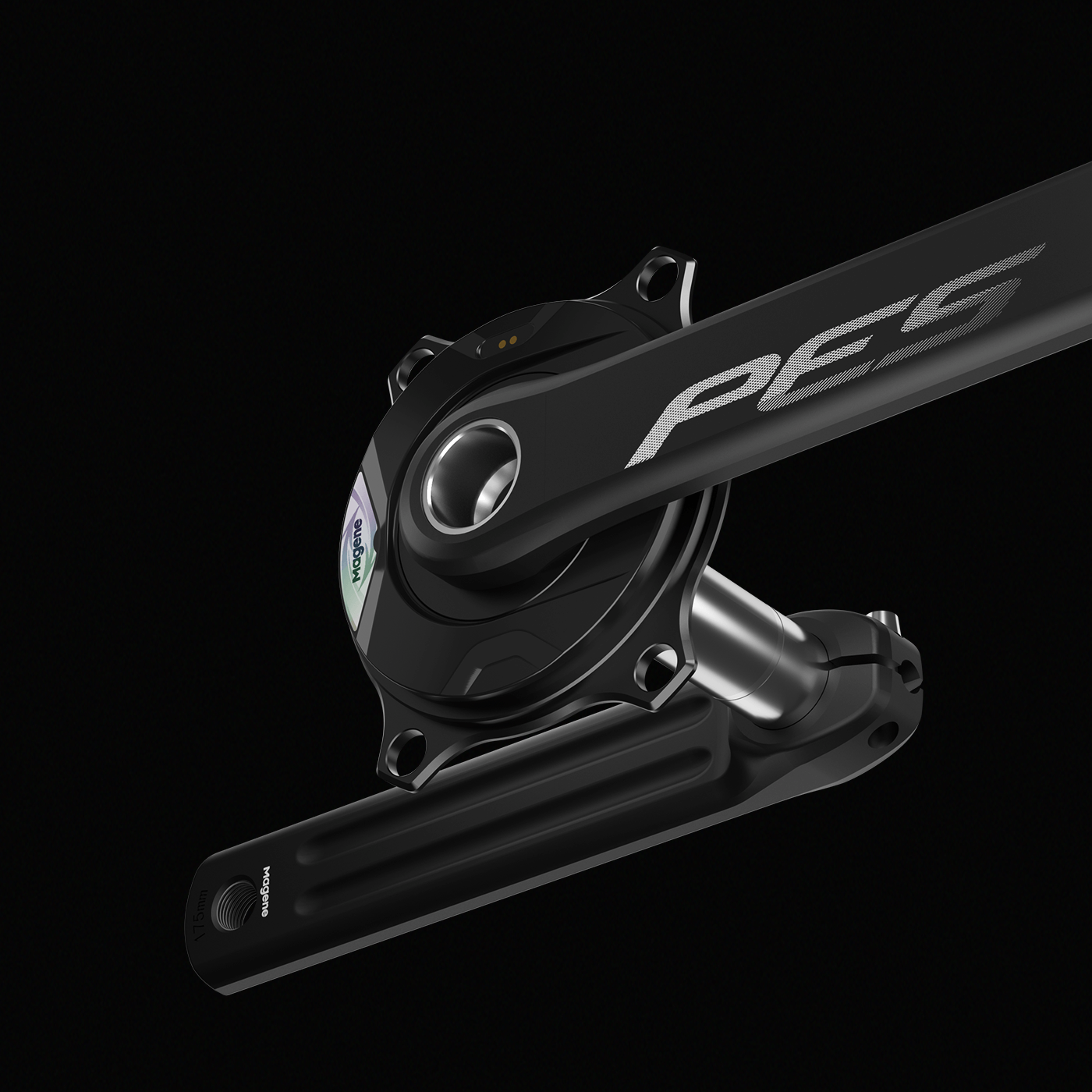
I installed the 170mm Magene unit on my gravel bike and paired it to my Hammerhead Karoo. I then set my gravel bike up on my Neo 2 and did some testing; dual recording the power from both devices to see how they compared. For context, my chain on my gravel bike is well past replacement – my chain checker reads 0.75 – and I haven’t swapped it because I was about to get the bike serviced and am just waiting for some parts. This matters because a worn drivetrain is less efficient, and that can make the difference between crank and turbo trainer readings a bit larger than normal.
Test Protocol
The test included:
- Steady riding at various cadences,
- Three sprints,
- And a structured step test of 30 seconds each at 150, 200, 250, 275, 350, 400, and 500 W, with a-minute or so easy riding between efforts.
I also zeroed the Magene before the ride and again midway through, just to be sure.

Results: Step Test
- 350 W: Neo 349 W vs Magene 360 W → +11 W (3.1%)
- 400 W: Neo 376 W vs Magene 386 W → +10 W (2.7%)
- 500 W: Neo 457 W vs Magene 470 W → +13 W (2.8%)
From about 350W upwards, the difference was right in line with what you’d expect from drivetrain losses alone, which is a very good sign. At lower powers, the larger percentage differences are probably due to the worn chain, plus how the Neo and Magene handle very low, smooth pedalling.
While the Tacx Neo 2 is widely regarded as highly accurate, it’s still a closed system. Without a calibrated reference such as a weighted static test or a laboratory torque rig, we can’t say with certainty which device is ‘right.’
What we can say is that from 350W upwards, the difference between the Magene and the Neo matched the expected 2–3% drivetrain loss almost perfectly – suggesting both units are performing very well in that range.
Results: Sprints
For sprints, the picture was more mixed:
| Sprint # | Neo Peak (W) | Magene Peak (W) | Winner |
|---|---|---|---|
| Sprint 1 | 603 | 623 | Magene |
| Sprint 2 | 803 | 787 | Neo |
| Sprint 3 | 610 | 607 | Tie |
Interestingly, the Neo tended to spike slightly higher at the absolute instant of peak power – probably due to its sampling method – but the Magene held the power slightly more steadily over the following seconds. This meant that 5-second averages were often similar, or slightly higher on the Magene.
Steady Riding
Over the final 15 minutes of the test (recovery between efforts), averages were:
- Neo: 114 W
- Magene: 119 W
- Difference = +5 W (4.4%)
This again fits well with expectations for an older drivetrain.
Calibration and Adjustability
One area where the PES-515, like the PES-505 before it, falls short compared to premium meters like SRM, Quarq, or Power2Max is in static calibration. With those older systems, you could hang a precisely measured weight from the crank and check the frequency response of the strain gauges, adjusting the calibration slope if needed. I still have a set of ISO-certified weight plates for this exact purpose. Unfortunately, the Magene (like most modern power meters) doesn’t allow this. All you can do is a zero-offset at rest. For most riders this is fine, but it does mean there’s no way to verify absolute accuracy at home.

Conclusions
The PES-515 delivered a very consistent, predictable performance in my testing:
- At race-level power outputs, it matched what you’d expect from a high-quality crank-based meter versus a Neo, coming in around 2–3% higher.
- Sprints were well-tracked, with both units responding quickly and the Neo very slightly quicker to show the instantaneous peak.
The lack of true static calibration is a limitation, especially for those of us who’ve spent decades checking and fine-tuning SRMs. But for most riders, the PES-515 offers very solid accuracy at a fraction of the cost of those legacy systems.
If your drivetrain is in good condition and you zero the meter regularly, the Magene PES-515 looks to be an excellent, affordable option for accurate power measurement. It’s a clear evolution of the 505 and a worthy competitor in the budget crank-based power meter space.
I will also redo the checks, when a new chain has been installed and my bike serviced. Check out the Magene PES 515 on their UK website.
Who are Magene?
Magene was founded back in December 2015 as the Qingdao Magene Intelligence Technology Co.Ltd. Their first product was the Gravat a smart trainer. After that they went on to produce a whole host of cycling tech. Such is their expertise, the company now produce many other companies’ products.


